
Elliott Wave Theory
Elliott Wave Theory interprets market actions in terms of recurrent price structures that follow the Fibonacci sequence. Basically, Market cycles are composed of two major types of Wave : Impulse Elliott Wave and Corrective Elliott Wave. Impulse wave can be sub-divided into a 5-wave structure (1, 2, 3, 4, 5), while a corrective Elliott Wave can be sub-divided into a 3-wave structures (a, b, c).
Elliott Wave Theory Background

R. N. Elliott
The Elliott wave theory was born from a set of articles written in the 1930’s by R. N. Elliott, from his studies mainly on the Dow Jones Industrials index, the U.S. Stock Market. He noticed that the market tended to move in certain patterns. He then surmised that these patterns could be used to predict certain future price movements. In essence, he noticed that most strong trends tended to unfold in 5 waves in the direction of the main trend, and which were connected by certain corrective patterns.
He also noticed that when each pattern was complete, it then formed part of a larger-degree pattern. He also surmised that each pattern not only unfolded as part of a larger-degree pattern but also sub-divided into a minor pattern where the impulsive swings (the ones in the direction of the main trend) tended to unfold in 5 waves connected by corrective patterns (the simplest of which was the ABC). He then surmised that if a market analyst pinpointed where in this pattern the market currently was, then he (or she) should be able to predict where the market would go from here. In essence, the Elliott wave theory allowed you to predict future market movements.
This is very different from many technical analysis techniques available today, where most of them are lagging indicators that show you when a market turn has unfolded in the past. Elliott wave theory is designed to be predictive in nature and as such should be considered a leading indicator, with the future movement of a market able to be anticipated, once the current position is established. So, if you were able to determine accurately where in this current pattern you are, the Elliott wave theory should then be able to predict where the market should go in the future.
Elliott Wave 1 Theory
Elliott Wave (1) is the first or initial swing off a important high or low.
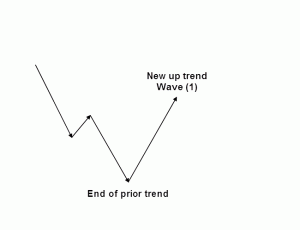
Elliott Wave (1) is rarely obvious at its inception. When the first wave of a new bull market begins, the fundamental news is almost universally negative. The previous trend is considered still strongly in force. Fundamental analysts continue to revise their earnings estimates lower; the economy probably does not look strong. Sentiment surveys are decidedly bearish, put options are in vogue, and implied volatility in the options market is high. Volume might increase a bit as prices rise, but not by enough to alert many technical analysts.
As such, Wave (1) is the initial swing off an important high or low.
Elliott Wave 2 Theory
Elliott Wave (2) is the first correction against the new trend
Elliott Wave (2) corrects wave (1), but can never extend beyond the starting point of wave one. Typically, the news is still bad. As prices retest the prior low, bearish sentiment quickly builds, and the crowd mentality reminds all that the bear market is still deeply ensconced. Still, some positive signs appear for those who are looking: volume should be lower during wave (2) than during wave (1). Wave (2) usually unfolds as a simple 3-swing abc pattern.
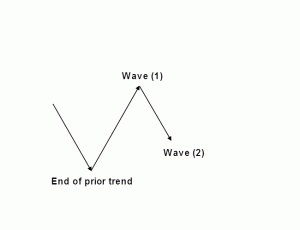
As such, Wave (2) is the first correction following the initial swing off an important high or low.
Elliott Wave 3 Theory
Elliott Wave (3) is usually the strongest and longest wave.
Elliott Wave (3) is usually the largest and most powerful wave in a trend. The news is now positive and fundamental analysts start to raise earnings estimates. Prices rise quickly, corrections are short-lived and shallow. Anyone looking to get in on a pullback will likely miss the boat. Trading the Wave (3) is usually the most profitable.
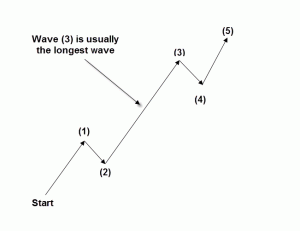
As such, Elliott Wave (3) is usually the longest and strongest in a completed 5 wave sequence.
Elliott Wave 4 Theory
Elliott Wave (4) usually unfolds as a complex correction
Elliott Wave (4) although being corrective, can be tricky to trade. Prices may meander sideways for an extended period, and Wave (4) typically retraces less than Wave (2) did. Volume is well below than that of wave (3). However, Wave (4) can still offer a buying opportunity if you understand the potential ahead for wave (5).
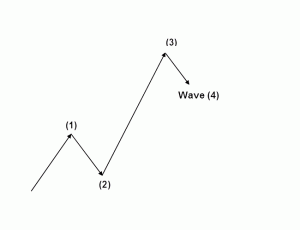
A such, Elliott Wave (4) is the correction before the final Wave (5) swing.
Elliott Wave 5 Theory
Elliott Wave (5) is the final leg before the top
Wave (5) is the final leg in the direction of the dominant trend. The news is almost universally positive and everyone is bullish. Unfortunately, this is when many average investors finally buy in, right before the top. Volume is often lower in Wave (5) than in Wave (3), and many momentum indicators start to show divergences (prices reach a new high but the indicators do not reach a new peak).
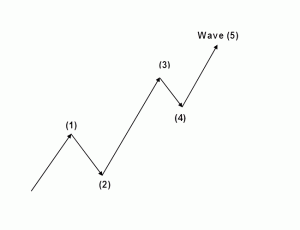
As such, Elliott Wave (5) is the final leg before the ultimate top.
Elliott Wave C Theory
Elliott Wave (C) is the end of the correction
Wave (C) is the most important wave in the whole sequence. The reason for this is simple. Because once a Wave (C) is complete, the whole ABC correction is complete. And when the whole ABC correction is complete, the prior major trend then resumes. As such, the end of the Wave (C) represents the best point to enter a new trade.
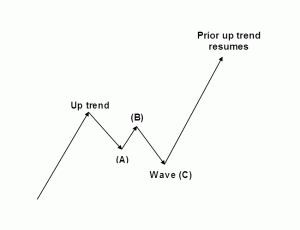
As such, Elliott Wave (C) is the end of the correction, before the prior trend resumes.
